
Henri Matisse
Rødt interiør med opstilling
1947
An official Louisiana exhibition poster kept in circulation by the museum's own shop.

Henri Matisse spent seven decades reshaping how colour and line describe pleasure. Trained as a lawyer before turning to painting in his twenties, he led the Fauves at the start of the century and, bedridden late in life, invented the cut-out as a way to continue drawing with scissors. The Vence Chapel, completed in 1951, is his summation.
Matisse worked toward what he called "an art of balance, of purity and serenity." In the final decade, unable to paint at the easel, he cut painted paper into shapes his assistants pinned to the studio walls — drawing in colour, direct and unhurried.
Objects
Rødt interiør med opstilling
1947
An official Louisiana exhibition poster kept in circulation by the museum's own shop.
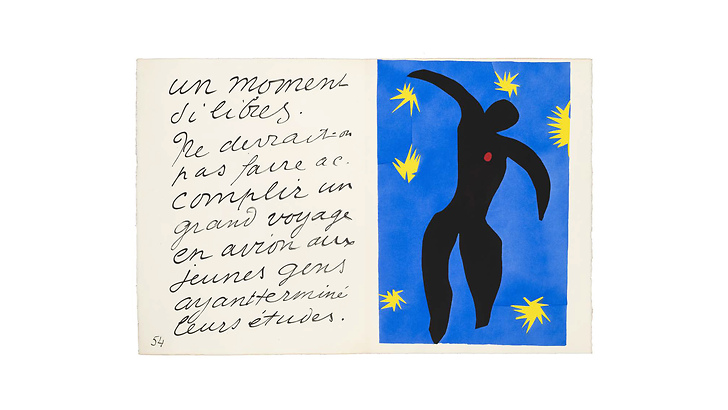
Icare — Limited Edition
2024
Extracted from the reissued Jazz portfolio, Icare distills Matisse's late paper cut-outs to their essential gesture: a floating body, a red heart, a scatter of stars. Printed color-by-color on a Marinoni-Voirin press at Draeger — the historic printer of the original Jazz plates — each pass approaches the depth and flatness of the gouached cut-out itself.

Zulma
Encountered via Perrotin Store Paris.
$1,024
Official source: Perrotin Store.
Françoise Gilot on Henri Matisse | Artist Interview | TateShots
Major Works
Museums & Public Collections
Influences
Related Artists
Selected Exhibitions
Publications
Interviews & Writing